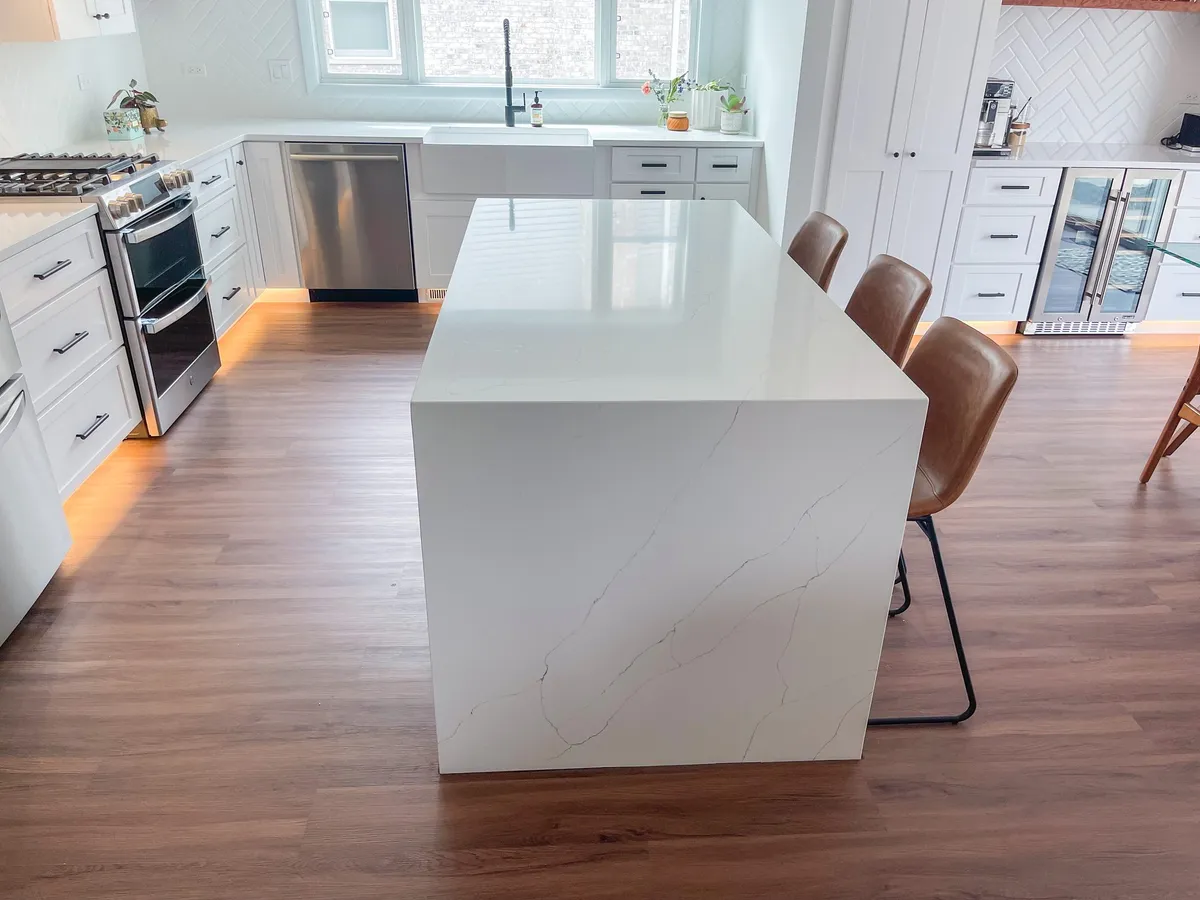
Quartz vs Granite Countertops for DuPage County Kitchens
Of all the choices in a new kitchen, the countertop is the one people worry about most. And the question I hear first, almost every time, is quartz or granite?
Both are good choices, and both hold up well in a busy kitchen. They are made very differently, though, and that changes how they look, how you care for them, and how they handle a hot pan. Here is how I explain the difference at a kitchen design visit.
What each one is
Granite is natural stone. It is quarried from the earth, cut into big slabs and polished. No two slabs are exactly alike. The color, the speckles and the veins are whatever nature put there.
Quartz is engineered stone. It is made in a factory from crushed quartz mixed with resins and pigments, then pressed into slabs. OSHA notes that crystalline silica can make up as much as 95 percent of engineered stone, with resin and pigments holding it together. Because it is made, the color and pattern are controlled, so a quartz slab looks very much like the sample you picked.
One word of caution on names: quartzite is not quartz. Quartzite is a natural stone, like granite. We install all three: quartz, granite and natural stone like quartzite.
How they look
If you want a countertop that is one of a kind, granite is hard to beat. Every slab is different, and some have bold movement that becomes the focal point of the kitchen.
If you want a clean, even look, quartz is easier. Solid colors, soft veining and marble-like patterns are all available, and what you see in the sample is close to what you get. Quartz is also a popular choice for a full-height backsplash or a waterfall edge on an island, where you want the pattern to stay consistent.
With granite especially, I tell people to pick the actual slab, not just a small sample. You'll do that at the showroom of the countertop company that wins your bid. Before you go, borrow a few cabinet door samples from our showroom on Hale Street so you can hold them right up against the stone.
Stains and sealing
This is the biggest day-to-day difference.
Quartz is not porous, so it does not need sealing. Spills wipe up with soap and water.
Granite is porous to some degree, and how much depends on the stone. A sealer helps it resist stains. In its countertop testing, Consumer Reports rated quartz and granite among the most durable countertops on the market, and it advised resealing granite periodically to keep it water and stain resistant. The Natural Stone Institute says how often depends on the stone's porosity, and that many sealers last anywhere from one to ten years. A simple check: if the stone around the sink starts to look darker after it gets wet, it's time to reseal.
Heat
Here the two trade places.
Granite handles heat well. Stone-care companies still recommend a trivet, because high heat can wear on the sealer, and in rare cases a big temperature swing can crack stone.
Quartz is more sensitive to heat, because of the resin that holds it together. Quartz makers' care guides say that strong or long heat can discolor or scorch the resin, and they tell owners to always use trivets or hot pads under hot pans, slow cookers and other countertop appliances.
So if you cook a lot and like to set pans down right off the stove, think about which habit you're willing to change. Either way, a trivet by the range is a good idea.
Everyday living
Both are hard, durable surfaces. Consumer Reports put them at the top of its durability ratings. Still, cut on a cutting board, not on the counter, and wipe up acidic spills like lemon juice or wine, especially on stone that hasn't been sealed in a while.
For busy families, the main difference is upkeep. Quartz asks for nothing but cleaning. Granite asks for an occasional reseal. Neither one is fussy.
Three choices that matter as much as the material
Whichever you pick, three smaller decisions shape how the countertop looks and works. You'll tell them to the countertop measurer, so it helps to think about them early.
Edge style. This is the shape of the front edge of the counter. Simple, rounded edges are easy to keep clean. Fancier profiles add detail.
Overhang. If you want bar stools at an island or peninsula, the counter reaches past the cabinets to give you knee room, usually 8 to 12 inches.
Backsplash height. With a tile backsplash, the tile usually runs right down to the counter, so you may not need a stone backsplash at all. A full-height quartz backsplash is another option, and it means no grout lines to clean behind the range.
A quick way to decide
You want a one-of-a-kind stone with natural movement: granite or quartzite.
You want an even pattern, a solid color, or a marble look without the upkeep: quartz.
You never want to think about sealing: quartz.
You set hot pans down without thinking: granite, and keep a trivet nearby anyway.
You're planning a full-height backsplash or a waterfall island: quartz is a common pick.
How countertops work with us
Countertops are part of our kitchen remodeling work. Two countertop companies bid on your kitchen, which keeps prices fair and service sharp. You're always welcome to bring a company you already like.
The countertop company measures on the second day of the cabinet install. The tops are usually ready about 6 to 10 days later, and they install them, drill the faucet hole and set your sink. It's all on your day-by-day calendar, and your prices are good for one year.
We remodel kitchens all over DuPage County, from Naperville to Downers Grove and our home base in Wheaton.
Still torn between quartz and granite? That's normal, and it's what the free design visit is for. Call me at (630) 890-3379. I answer my own phone, 8 AM to 10 PM, seven days a week.
Questions homeowners ask
Is quartz the same as quartzite?
No. Quartz is engineered stone made from crushed quartz and resin. Quartzite is a natural stone that is cut from the earth, like granite. We install both.
Does quartz need to be sealed?
No. Quartz is not porous, so it doesn't need sealing. Clean it with mild soap and water.
How often does granite need to be sealed?
It depends on the stone. The Natural Stone Institute says many sealers last one to ten years. If the stone near the sink darkens when it gets wet, it's time to reseal.
Can I set a hot pan on quartz?
It's best not to. Heat can mark the resin in quartz, so quartz makers recommend trivets or hot pads under hot pans and appliances. Granite handles heat better, but a trivet is still a good habit.
How do I get started?
Call me at (630) 890-3379 for a free design visit. Two countertop companies bid on your kitchen, and you pick your slab at the winner's showroom.
